The Renewable Energy Program by Tatai-Miscantus Ltd.
The Basis of Tatai-Miscanthus Programme
The energy reed Miscanthus Sinensis Tatai is a patent protected plant.
Patented technologies: an industrial-scale propagation technology and small power plants of 5-10 KW capacity -further patenting of 15-750 kW units is in progress.
All elements and stages of the program are available for inspection.
The Cornerstones of the Program
Climate amelioration: CO2 absorption, 8 901 415 tons/year
CO2 sequestration by biochar: 775 385 tons/year
Taking lands into production – recultivation of wastelands by reed plantation.
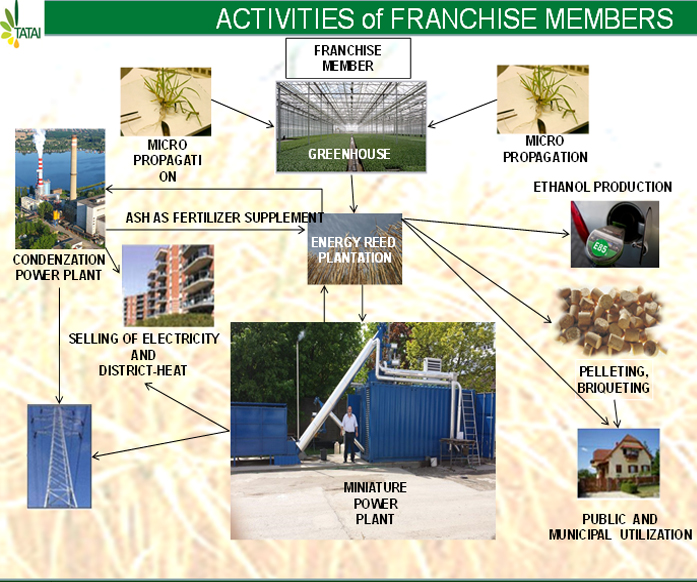
The energy reed utilized as fuel for small or larger power and heating plants - pellets, briquettes and cellulose based ethanol production.
Establishing micro propagation plants and greenhouses – highly efficient seedling production according to the patented technology.
The Key Advantages of the Program
Energy independence -e.g. replacing import gas
The capacity of the system is scalable and its limitation is the amount of suitable land available.
Modest investment is required in view of the potential yield.
Short-term return.
Wasteland recultivation.
Energy Impact
It is possible to produce electricity and heat by small power plants locally and with high efficiency.
The power plants can be installed in containers.
It is possible to set up a network of the power plants or to deploy them individually.
The total energy demand of 2-3 average European detached houses can be met by 1 ha of ’Tatai’ plantation
To cover the heat and electricity demand of 3.000 households in a small town of 10.000 inhabitants 1500-1600 ha ’Tatai’ energy reed plantation is required.
The energy is produced by the system from locally generated materials.
Great heating technology with high heating values (16,2–18,2 MJ/kg), low ash content (3,5–5%), which could be reused as an alternative fertilizer.
Minimal emission of hazardous material.
Great automation possibilities.
Cellulose based ethanol available at a reasonable price.
Miscanthus Sinensis ’Tatai’, the Registered Plant
The ’Tatai’ is a perennial plant. Its reed like shoot is strait, compact and not branching with a diameter of 10-13 mm, and height of 3–6 m
The moisture content is low, 8-12 %, during the harvest period.
It is ready for cultivation in almost all types of soil (sandy, clay, etc.) and with chemical reaction (pH 5,5-8,5).
To achieve 22 tones/ha of dry material, about 300-400 mm of precipitation is sufficient in the season of growth.
Temporary floods are tolerated.
Drought and frost (-35 Celsius) resistant.
The annual harvested yield is beyond average.
Quickly turns productive (30-40 % of the gross yield in the second year, 70-80 % of the gross yield in the third year, then 100 % available for harvest).
Long life-time, re-planted turnover is minimum 25 years.
Known diseases and pests are not known in Europe.
Noninvasive (does not extend beyond planted territories, and provides natural habitat for fauna).
The leaf mould process significantly improves the balance of soil nutrition.
Seedling production
It requires reasonable investments for financial performance.
It has no germinated seeds, thus can only be reproduced in a vegetative way.
Minimum 30.000 ha of unsuitable land for food production (such as flood plains, lands near motorways, remediation lands, etc.) can be settled yearly with seedlings released from the greenhouse and micro propagation laboratories as a result of several years of research and development.
Environmental Impact
In contrast to fossil fuels the annual CO2 balance is zero, since the actual volume of CO2 emission is lower than the amount of CO2 absorbed from air in the prior year.
1000 kg of ’Tatai’ energy reed produces 1230 kg oxygen.
1000 kg ’Tatai’ energy reed absorbs 1690kg CO2.
Outstanding Investment
The Program offers vast energy production capability
Once the program is initiated growth is exponential due to high yields
It is available on remote areas not connected to the grid.
The Program is ready to be launched in several European countries with guarantees provided by governments
A remarkable return rate of 3-4 years is available in the renewable energy sector, while the average return rate in the agronomy is between 6-7 years.